Before the Phone Map: How Travellers Found Their Bearings
Before the phone map, travelers used street signs, transit boards, and local directions to get around. Learn which old wayfinding habits still help on a short break.
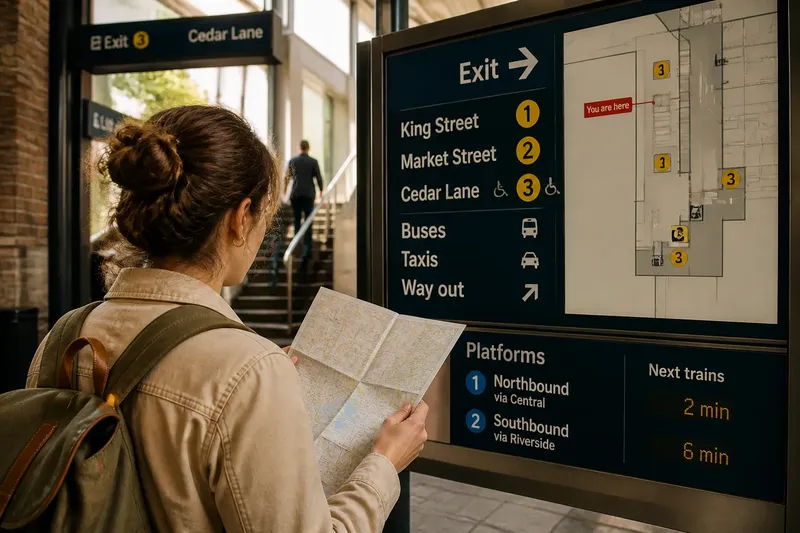
Before the phone map, travelers got directions from people, posted signs, and the names of streets they could see. Those old wayfinding habits still help on a weekend trip, especially when a station exit is confusing or a phone screen points to the wrong entrance.
Finding your bearings does not require memorizing a route or carrying a paper atlas. It means knowing what to ask, which sign to trust, and how to confirm that you have reached the right doorway. A phone can supply the route; the place itself supplies useful checks.
What could a station sign tell you that a map could not?
Transit stations are small puzzles of exits, platforms, and street-level entrances. A map pin may land near a building without telling you which side has the entrance you need. Station diagrams and exit signs answer a more immediate question: where does this passage lead?
Look for exit names, street names, neighborhood labels, and symbols for elevators or accessible routes. If a sign lists several streets, compare those names with the destination address before heading outside. At a large station, the wrong exit can leave you on the opposite side of a rail line or a busy avenue.
When signs conflict with an app, stop before leaving the station. Check the station’s posted map or ask staff which exit serves the street you need. For service changes or accessibility information, treat official station notices as more current than a general map app.
How did people ask for directions before an app?
They asked someone who knew the immediate area: a station employee, shopkeeper, hotel desk clerk, or passerby. The most useful questions were specific enough to answer in a sentence. “Which exit leads to King Street?” is easier to resolve than “How do I get across town?”
Confirm the answer with something visible. If someone points you toward an exit marked “Market Street,” check that sign before following the crowd. Local guidance can clarify a confusing entrance or an unmarked passage, while signs help verify that you heard correctly.
Imagine you have arrived at a station with two exits and your hotel address is on Cedar Lane. Your app places the hotel near the station but does not identify the right side. You ask an employee which exit leads toward Cedar Lane, then match that street name to the exit board. The resulting decision is clear: take the signed exit, or ask again if neither board lists the street.
When is a paper map still useful?
A paper map is useful when you want to see street names and transit lines together, or when a phone battery or connection may be an issue. It is less convenient for live service changes and can become outdated, so use it for broad reference rather than assuming every detail is current.
If you carry one, choose a map that covers the area you plan to visit and check its publication information. A transit operator’s printed network map can clarify how lines connect; a visitor map may show public buildings and pedestrian routes. For closures or current access rules, check official notices or ask staff.
Which old wayfinding habits still help today?
- Check the exit label against your destination street. If the street name matches, take that exit; if not, stay inside and check another sign or ask staff.
- Read the platform and service boards before boarding. If the destination and direction match your plan, board; if they do not, wait and confirm the correct platform.
- Look for posted street names at a confusing junction. If the sign matches the address or route, continue; if it does not, pause and verify your location.
- Compare an app’s entrance pin with the building’s signs. If the named entrance is visible, use it; if the pin points to a blank wall or closed door, check the building directory or ask staff.
- Save the address in written form as well as on your phone. If the screen is unavailable, use the saved street and building name to ask for help; if the address is incomplete, look it up before leaving a reliable connection.
- Ask a precise local question when signs leave a gap. If the answer names a visible street, exit, or platform, confirm it on a sign; if it remains vague, ask station staff or consult an official notice.
What should you do when signs and directions disagree?
Should I follow the app or the station signs?
For platform changes, closures, and station access, check official station signs and staff guidance first. If the app’s route still conflicts, pause and confirm the destination or entrance before moving on.
What if the street name is missing from the exit board?
Look for a nearby intersection, neighborhood name, or landmark listed on the station map. If those clues do not identify the right exit, ask an employee rather than guessing.
How can I get directions without sharing my destination with a stranger?
Ask about a public reference point near your destination, such as a station entrance or library. Then compare the answer with posted signs and your own map before continuing.
What should I do if my phone battery is low?
Use a station map or posted street signs to identify the next public place where you can ask for help. If you have a written address or a saved offline map, use that rather than relying on a live connection.
How can a short trip leave you more confident about getting around?
Keep one useful detail from each unfamiliar transfer: the street name on the right exit, the platform direction, or the public entrance that actually opens onto the destination side. These are practical notes, not a route to memorize. If you return, they can help you make a more informed choice before leaving the station.
The phrase “before the phone map” points to a simple skill, not a demand to travel without technology. Use the phone for route options, then verify the detail that matters most with a sign, an address, or a person who knows the station. That small check can turn a confusing arrival into a clear next move.